Vitamin E might be one of the most recognizable ingredients on any skincare label — but familiarity doesn’t always mean people understand what it’s actually doing. Vitamin E for skin isn’t just a marketing checkbox; it’s a genuinely functional antioxidant with a clear, well-understood role. Here’s what it does, and why it’s part of our balm.
What Is Vitamin E, and Why Does Skin Need It?
Vitamin E is a fat-soluble antioxidant, meaning it dissolves in oil rather than water — which is exactly why it integrates so naturally into an oil-and-fat-based balm rather than a water-heavy lotion. Your skin is constantly exposed to environmental stressors like UV light, pollution, and everyday oxidative stress, all of which generate free radicals. Vitamin E’s core job is neutralizing those free radicals before they can damage skin cells.
The Key Benefits of Vitamin E for Skin
1. Antioxidant Protection
Vitamin E helps protect skin from free radical damage, which is one of the underlying contributors to premature aging and dullness. By neutralizing these unstable molecules, vitamin E helps support skin’s overall resilience against daily environmental exposure.
2. Supports Skin Barrier Function
Vitamin E helps reinforce the skin’s natural barrier, making it more effective at retaining moisture and defending against irritants. A stronger barrier generally means calmer, less reactive skin over time.
3. Promotes a More Youthful Appearance
Because of its antioxidant properties, vitamin E is commonly associated with supporting a smoother, more youthful-looking complexion, particularly when used consistently as part of a broader skincare routine rather than as a standalone treatment.
4. Works Synergistically With Other Antioxidants
Vitamin E is known to work particularly well alongside other antioxidant-rich ingredients, enhancing their combined stability and effectiveness. This is part of why it pairs so naturally with ingredients like olive oil and manuka honey, both of which carry their own antioxidant properties.
5. Naturally Moisturizing
Beyond its antioxidant role, vitamin E also has emollient properties, meaning it helps soften and smooth skin texture directly, in addition to its protective function.
Why We Include Vitamin E in Our Balm
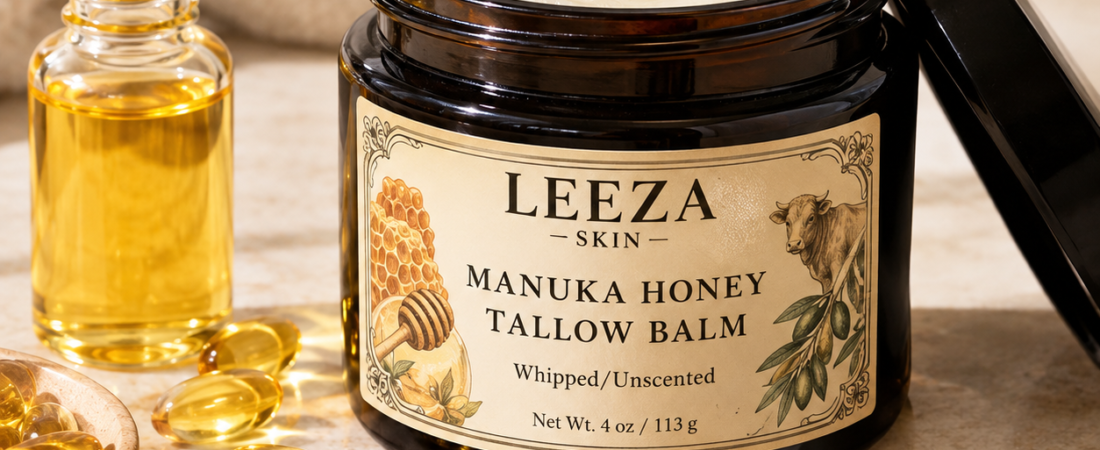
In our Manuka Honey Tallow Balm, vitamin E works alongside grass-fed tallow, manuka honey, olive oil, jojoba oil, and shea butter to round out the formulation’s overall antioxidant protection. While tallow and shea butter handle deep moisture and barrier repair, vitamin E adds a layer of protective support that helps the other ingredients do their job more effectively over time, rather than working in isolation.
(See our complete ingredient breakdown for how all six ingredients work together.)
How to Get the Most From Vitamin E-Enriched Skincare
- Apply consistently, since antioxidant benefits build cumulatively with regular use rather than appearing after a single application.
- Pair with sun protection during the day — vitamin E supports skin health, but it isn’t a substitute for SPF against UV damage.
- Use morning and night as part of a simple, consistent routine, rather than sporadically.
Who Should Be Cautious With Vitamin E?
Vitamin E is generally very well tolerated, but as with any ingredient:
- Very sensitive skin may occasionally react to concentrated vitamin E oil used on its own; blended formulations (like ours, where it’s balanced with five other ingredients) are typically better tolerated than pure vitamin E oil applied directly.
- New products always deserve a patch test first, regardless of how gentle an ingredient is generally considered. (See our full patch test guide for exact steps.)
Frequently Asked Questions
Does vitamin E help with scarring? Vitamin E is commonly used for this purpose, and its moisturizing and antioxidant properties may support the skin’s appearance over time, though results vary and it shouldn’t be treated as a guaranteed scar treatment.
Can vitamin E clog pores? In concentrated, undiluted form, vitamin E oil can feel heavy for some skin types. In a balanced formulation with lighter ingredients like jojoba oil, this risk is significantly reduced.
Is vitamin E the same as retinol? No — they’re different ingredients with different mechanisms. Vitamin E is primarily an antioxidant, while retinol is a vitamin A derivative that works on cell turnover. Some routines use both, but they serve different roles.
How does vitamin E compare to the other antioxidants in your balm? Manuka honey and olive oil both bring their own antioxidant properties, while vitamin E specifically targets free radical protection at the cellular level. Together, they provide broader antioxidant coverage than any single ingredient alone.
Final Thoughts
Vitamin E has stayed a skincare staple for a good reason — it’s a genuinely functional antioxidant, not just a familiar name on a label. Paired with grass-fed tallow, manuka honey, and four other purposeful ingredients, it’s one more piece of why our balm is formulated to actually protect and support skin, not just moisturize on the surface.
Ready to feel the difference? Shop our Manuka Honey Tallow Balm, formulated with real vitamin E and five other nourishing natural ingredients.